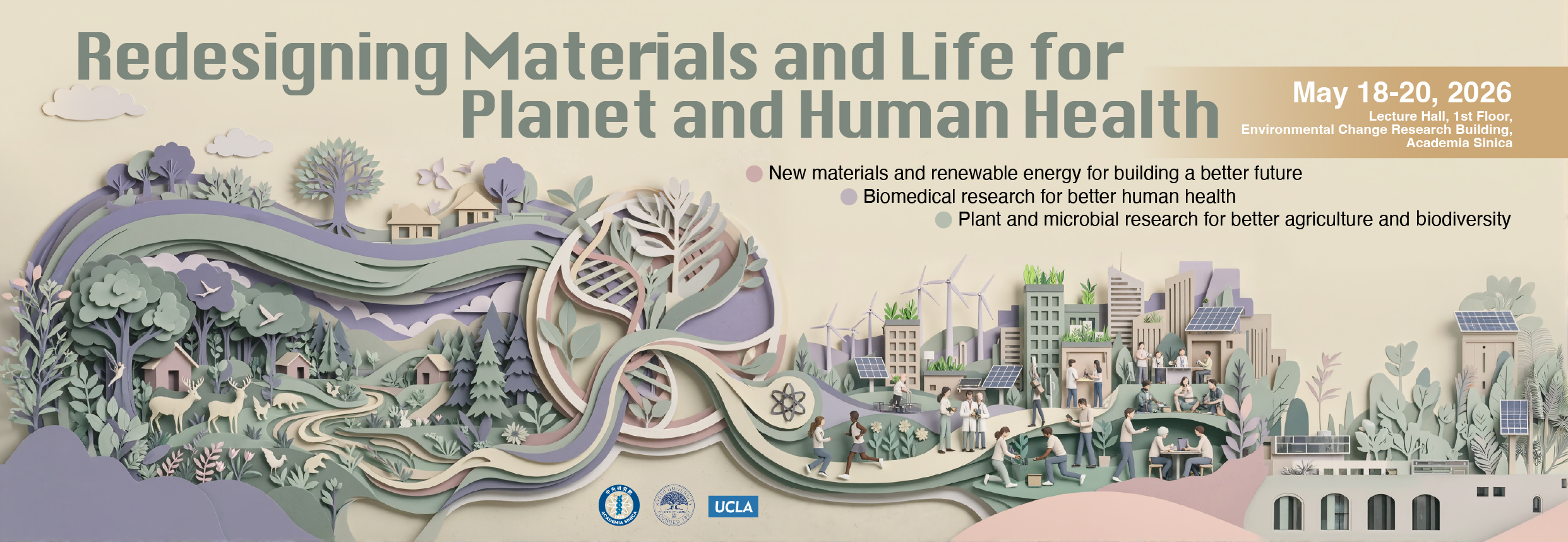
Redesigning Materials and Life for Planet and Human Health
event – location_on Academia Sinica, Taipei, Taiwan
The AS–KU–UCLA Symposium 2026 invites scholars from Academia Sinica, Kyoto University, and UCLA to address complex challenges at the interface of human and environmental systems.
Focusing on new materials and renewable energy, biomedical research, and plant and microbial science, the symposium brings together work that spans from molecular design to ecosystem dynamics.
"From molecules to ecosystems — advancing integrative approaches for a more sustainable future."
Building on the inaugural 2025 meeting at UCLA, UCLA–Kyoto University–Academia Sinica (Pan Pacific) Meeting: New Developments in Biomedical Sciences, the symposium expands from a biomedical focus to a broader cross-disciplinary framework.
Conference Schedule
New Materials and Renewable Energy for Building a Better Future
Opening Ceremony and Welcome Remarks
Designing Molecular Space: From MOFs to a Better Future
person Susumu Kitagawa, Kyoto University
Coffee Break (invited only)
coffeeNew Materials for Energy Efficient Nano-Scale Devices
person Jane P. Chang, UCLA
Endothermic Singlet Fission Process in Harvesting the High-Level Excitation Energy for Tetracene-Based Photodiodes
person Tzung-Fang Guo, Academia Sinica
Materials Science for Efficient Perovskite Solar Cells
person Tomoya Nakamura, Kyoto University
Group Photo and Lunch (invited only)
restaurantUnderstanding (and Controlling) Electrified Interfaces for Energy and Health
person Yuzhang Li, UCLA
Macromolecular Electrode Materials
person Hung-Ju Yen, Academia Sinica
Beyond Materials: Electrified Catalysis and Reactor Design for a Healthier Planet
person Carlos Morales-Guio, UCLA
Coffee Break (invited only)
coffeeControlling Emission and Photodetection in Atomically Thin 2D Materials with Plasmonic HfN-Gated Heterostructures
person Yu-Jung Lu, Academia Sinica
2D Materials Edges as a Platform for Electrocatalysis
person Ya-Ping Hsieh, Academia Sinica
Coacervate Protocells for Cell-Free Biomanufacturing
person Samanvaya Srivastava, UCLA
Day 1 Wrap-up and Discussion
Banquet (invited only)
Biomedical Research for Better Human Health
Engineering Multi-Pronged CAR-T Cell Therapies for Cancer
person Yvonne Chen, UCLA
Decoding Innate-Like Lymphocytes in Asthma: From Mechanisms to Therapeutic Opportunities
person Ya-Jen Chang, Academia Sinica
X Chromosome and Autoimmunity
person Maureen An-Ping Su, UCLA
Coffee Break (invited only)
coffeeTargeting Oncogenic EGFR and TIL Density in the GBM Immune Microenvironment
person Robert M. Prins, UCLA
Chemical Biology of Self-Assembly
person Motonari Uesugi, Kyoto University
Engineering a Potent T Cell Response against Melanoma
person Cristina Puig Saus, UCLA
Lunch (invited only)
restaurantElimination of Unwanted Cells: From Understanding to Control
person Jun Suzuki, Kyoto University / Academia Sinica
Single-Cell Dynamics by Omics
person Hirofumi Shintaku, Kyoto University
Two Large Biobanks at Academia Sinica
person Hsin-Chou Yang, Academia Sinica
Coffee Break (invited only)
coffeeBeyond the Pandemic: Uncovering the Drivers of Viral Spillover in a Changing Environment
person Shin-Ru Shih, Academia Sinica
Mechanisms of Ebola Virus Intracellular Replication
person Takeshi Noda, Kyoto University
Microbial Natural Product and Enzyme Discovery
person Yi Tang, UCLA
"DuraBle" Tolerance: How Do B Cells Establish Tolerance at the CNS Borders?
person Wei-Le Wang, Academia Sinica
Day 2 Wrap-up and Discussion
Dinner (invited only)
Plant and Microbial Research for Better Agriculture and Biodiversity
Strigolactones and LysM Proteins in Rice Architecture and Symbiosis
person Jian-You Wang, Academia Sinica
Research of Plant Growth Mechanism under the Brassinosteroid Signaling
person Takeshi Nakano, Kyoto University
Plant Drought Tolerance from Cells to Leaves to Ecosystems to Continent
person Lawren Sack, UCLA
Coffee Break (invited only)
coffeeRethinking Fungus-Cyanobacterium Symbiosis: When Cyanobacteria Build the House and Fungi Move In
person Ko-Hsuan Chen, Academia Sinica
Stability and Dynamics of Microbial Communities
person Hirokazu Toju, Kyoto University
Day 3 Wrap-up and Closing Remarks
Organizers